
Berks County Court Records After a Jail Arrest
Court records after a jail arrest in Berks County begin when the criminal case is filed in the Pennsylvania court system. The arrest and booking may place a person in county custody, but the docket is where formal charges, hearings, bail entries, dispositions, and sentence information are tracked. The Berks County District Attorney's Office prosecutes criminal charges after arrest, while the courts and Clerk of Courts maintain the court record once the case exists.
The custody side and the court side should be kept separate. Use jail inmate records when the question is whether a person is currently held, released, or listed through VINE/PA SAVIN. Use jail mugshots only for booking-photo questions, since Berks does not document a public mugshot gallery. For court records after an arrest, the key source is the Unified Judicial System docket, followed by the Berks County Clerk of Courts when copies, certifications, or filings beyond the docket sheet are needed.
How to Find Court Records After an Arrest in Berks County
Berks County's courts page points public criminal docket users to Pennsylvania's Unified Judicial System portal. UJS Case Search is useful because it accepts several identifiers that may appear on arrest paperwork, commitment documents, notices, citations, or docket sheets. A name search can work, but a docket number, OTN, complaint number, incident number, SID, or citation number is often more precise for common names.
UJS Case Search is the statewide entry point shown in the research, and the Berks option appears under county and judicial-district filters. The UJS interface shown below is the same case-search starting point used for public criminal docket lookups.
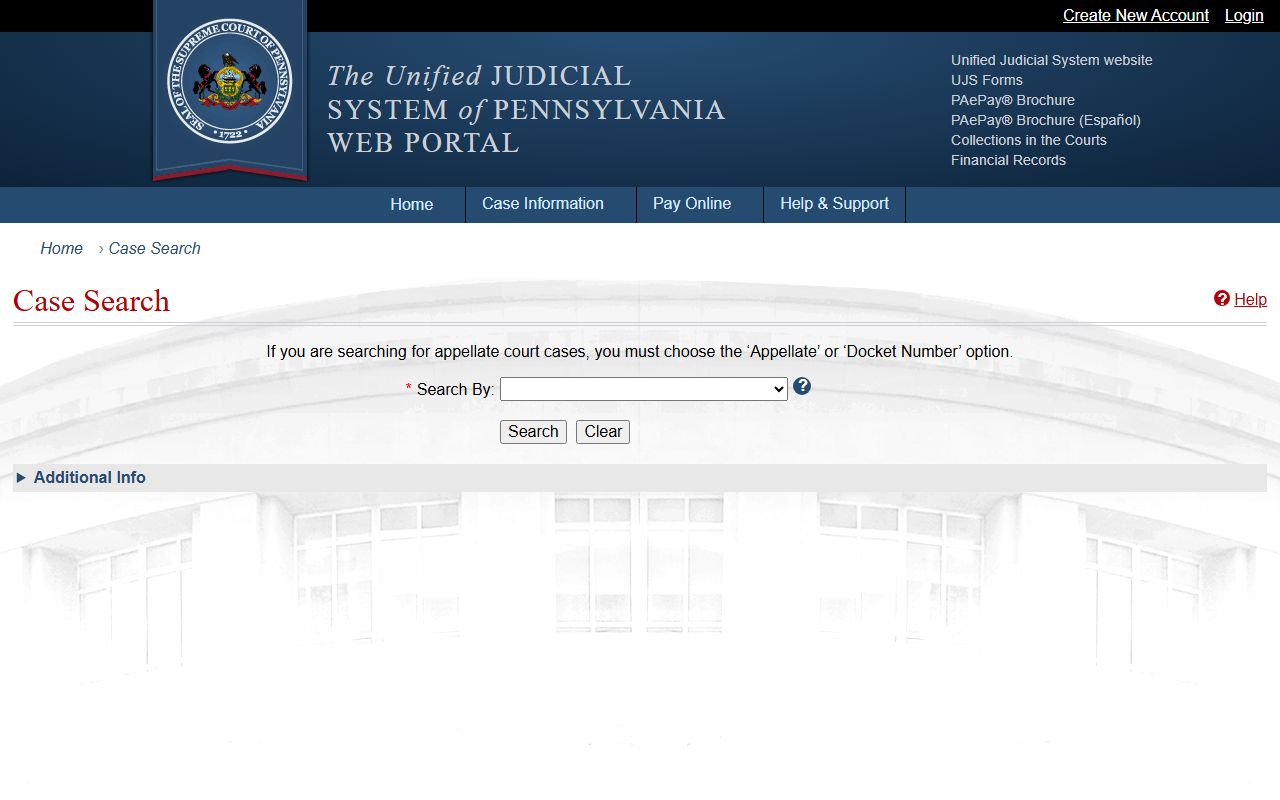
After opening a result, read the docket sheet as a court record, not as a live jail roster. Docket sheets may show charges, grading, bail events, hearing dates, docket entries, dispositions, and sentence information, while filings themselves may require a request to the Clerk of Courts.
| UJS Field | Type | How It Helps |
|---|---|---|
| Search By | Tab or option | Choose participant name, docket number, OTN, complaint number, incident number, SID, citation number, attorney, organization, calendar event, or another listed search mode. |
| Docket Number | Text | Best when a court notice, bail paper, or prior docket sheet already gives the case number. |
| Participant Name | Text | Useful when only the defendant's name is known; narrow with county and date fields when possible. |
| OTN | Text | Matches the offense tracking number often tied to criminal processing in Pennsylvania. |
| Complaint Number | Text | Can connect the court case to the criminal complaint or arrest paperwork. |
| Incident Number | Text | May help when police paperwork lists an incident identifier. |
| SID | Text | State identification number, if known; avoid relying on restricted personal identifiers. |
| Date Filed Start / End | Date fields | Narrows recently filed cases or older records within a time window. |
| County | Dropdown | Select Berks when searching local criminal court records. |
| Judicial District | Dropdown | Select Berks - 23 when that filter is available. |
| MDJS Court Office | Dropdown | Includes Berks magisterial district court offices, including central arraignment and Reading central court entries. |
Charging Documents After a Berks County Arrest
The charging document is what turns an arrest allegation into a court case. Initial police allegations, jail booking labels, and formal charges can differ because prosecutors review the evidence, add counts, amend counts, withdraw counts, or decline to pursue a charge. In Berks County, the District Attorney's Office is the prosecutor for local criminal cases. The office is located in the Berks County Services Center, 5th Floor, 633 Court Street, Reading, PA 19601, and lists phone 610-478-6000, fax 610-478-6002, email da@berkspa.gov, and weekday hours of 8:00 a.m. to 4:30 p.m.
| Document or Entry | What It Usually Does | Where to Look |
|---|---|---|
| Criminal complaint | Sets out initial charges or allegations after arrest or police filing. | UJS docket identifiers, magisterial district court record, or filing office. |
| Criminal information | States the prosecutor's formal charges for a Common Pleas case after the case advances. | Berks County Clerk of Courts or Common Pleas docket references. |
| Amended information or amended charge entry | Shows that a charge, grade, or count changed after filing. | UJS docket entries and Clerk records. |
| Disposition or sentence order | Records the outcome of a count or case after plea, verdict, dismissal, or sentence. | UJS docket sheet, Clerk of Courts, or sentencing court. |
Clerk, Court, and Prosecutor Details
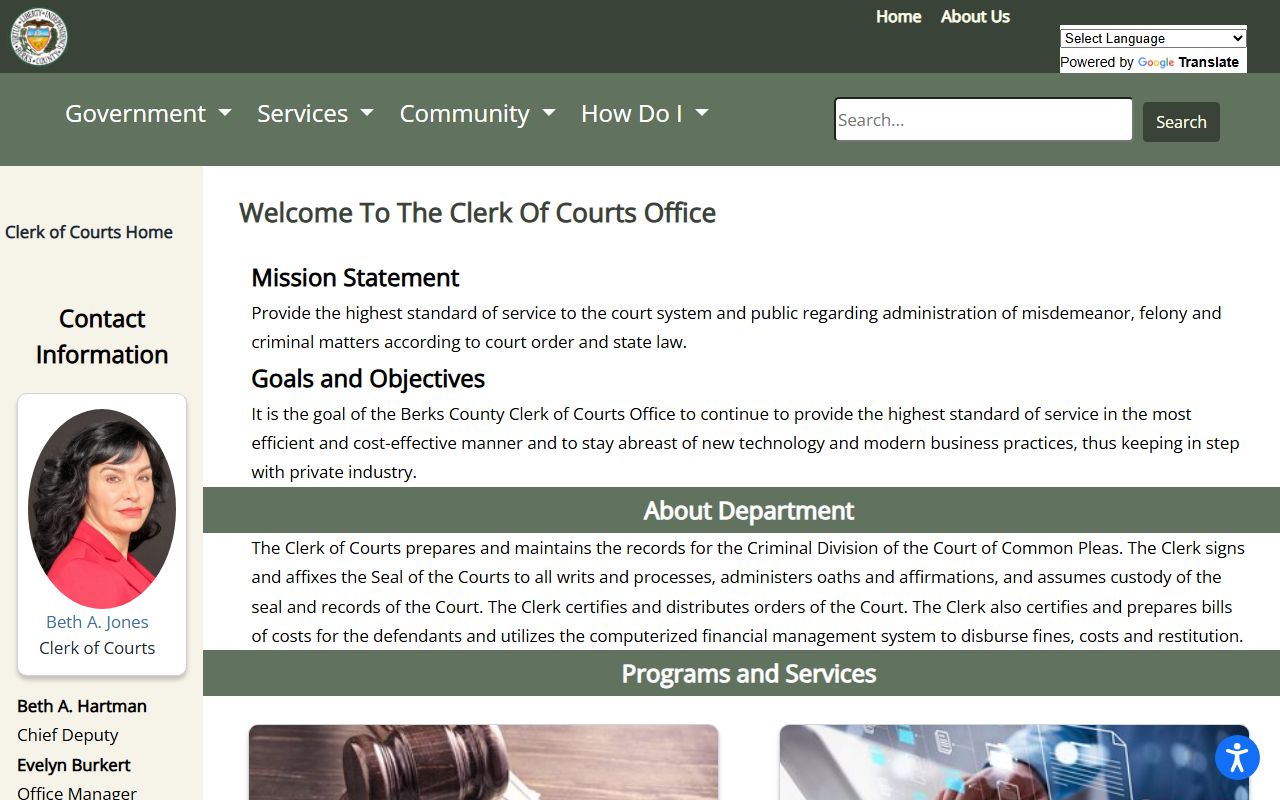
The Berks County Clerk of Courts maintains criminal division records for the Court of Common Pleas. The Clerk's official role includes preparing and maintaining criminal court records, signing and sealing writs and process, administering oaths and affirmations, keeping the seal and records, and certifying or distributing court orders. UJS docket sheets can identify filed documents, but actual copies, certified records, and older or non-downloadable filings may require Clerk contact.
The official Clerk page is a useful confirmation point when a UJS docket lists a filing but does not provide the document itself.
For charges after arrest, the DA decides how to prosecute while the court record tracks what was filed and what happened. Current Berks County materials list District Attorney John T. Adams and First Assistant District Attorney Dennis Skayhan. The DA page reports that the office works with local, state, and federal law enforcement and has prosecutors, detectives, analysts, and support personnel assigned to criminal justice work.
Charge Status in Court Records After an Arrest
Charge status is a snapshot, not a life story. A person can be arrested and booked on one set of allegations, then appear on the court docket with amended, reduced, added, withdrawn, or dismissed counts. Read each count separately, because one count may be resolved while another remains pending. Also check whether the docket is a magisterial district court matter, a Common Pleas matter, or both, since cases may move from initial proceedings into the Court of Common Pleas.
| Status | What It Means | Practical Note |
|---|---|---|
| Pending | The charge or case has not reached a final disposition. | Check upcoming hearings, bail entries, and docket-entry dates. |
| Amended | The charge, statute, grade, or count has changed after filing. | Compare older and newer docket entries before drawing conclusions. |
| Withdrawn or dismissed | A count or case has been removed by court action or prosecution decision. | Other counts may still remain active. |
| Nolle prosequi | The prosecutor is not pursuing the count or case. | It is a prosecution decision recorded in the court case. |
| Guilty plea or verdict | The charge has been adjudicated through plea or finding. | Look for sentence entries and final disposition details. |
| Disposition | The current or final outcome for a charge or case. | Always read the disposition for each count, not just the case caption. |
Bail, Holds, and Release After an Arrest
In Pennsylvania, bail is generally handled by the court, not by the jail as a standalone decision-maker. After arrest, a person may have a preliminary arraignment before a magisterial district judge or another judicial officer. The docket may show release on recognizance, unsecured bail, nominal bail, monetary bail, percentage or cash conditions, nonmonetary conditions, or detention/no release. The local jail can answer current custody and release-processing questions at 610-208-4800, but the formal bail terms come from the court record.
| Bail or Hold Type | How It Works | Why It Matters |
|---|---|---|
| Release on recognizance | Release based on a written promise to appear and obey conditions. | No upfront monetary payment is the core feature. |
| Unsecured bail | The person may owe the stated amount if conditions are violated. | It differs from cash paid at the start of release. |
| Monetary or cash bail | Funds must be posted as directed by the court. | Verify payment routing with the court or Clerk, not a caller demanding money. |
| Surety bail | A licensed bail agent or surety may be involved where allowed and accepted. | Confirm exact local acceptance and terms before acting. |
| No-bond hold or detainer | A court order, sentence, probation/parole detainer, other-jurisdiction hold, ICE hold, or transfer can block release. | Posting money on one case may not release the person if another hold remains. |
Berks planning research reviewed jail population snapshots from 2017 through 2021 and found that many people in the snapshot population were not simply awaiting a posted bond. Sentenced status, no-bond orders, and detainers can all keep someone in custody even when a docket also lists a bail amount in another case.
Warrants That Lead to Court Records After Arrest
A warrant can be the reason a person is arrested and booked, but the warrant list is not the same as the court docket. The Berks County Sheriff's Office has a Warrants division and a Most Wanted page, and its public materials list a tip hotline at 610-478-6390. The sheriff's main number is 610-478-6240 for residents concerned that the office may have reason to contact them.
UJS dockets may show bench warrants or case events tied to failure to appear, probation matters, or other court directives. The Sheriff's Most Wanted page and app can show public wanted-person postings and faces of suspects who remain at large, but that is not a complete warrant database and not a substitute for checking the relevant docket, court office, or legal counsel.
Charges vs. Convictions in Berks County Court Records
Being arrested and charged is not the same as being convicted. A charge is an accusation or count filed in a criminal case. A conviction requires a guilty plea, verdict, or other adjudication that results in guilt on a charge. Court records after arrest should be read with that distinction in mind, especially when some counts are dismissed and others proceed.
| Charge | Conviction | |
|---|---|---|
| Stage | Accusation filed in the court case. | Outcome after plea, verdict, or adjudication. |
| Proof level | Early-stage legal standards and prosecution filing decisions. | Guilt must be established through the criminal process. |
| Docket effect | May be pending, amended, withdrawn, dismissed, or resolved. | Usually appears with disposition and sentencing information. |
| Public interpretation | Should not be treated as proof of guilt. | Still verify exact count, date, and sentence from the originating court. |
Sealed vs. Expunged Court Records After Arrest
Pennsylvania public access is limited by more than ordinary Right-to-Know rules. Juvenile matters, sealed records, expunged records, criminal investigative records, personal or private information, and records controlled by court policy may not be available through a public web search. CHRIA, 18 Pa.C.S. Section 9121, governs dissemination of criminal history record information by criminal justice agencies. Expungement is addressed in part by 18 Pa.C.S. Section 9122 for qualifying criminal history information.
| Sealed or Limited Access | Expunged | |
|---|---|---|
| Public visibility | Restricted from ordinary public view when the law or court order applies. | Removed from public criminal history access under a qualifying order or statute. |
| Record existence | The record may still exist for limited court or agency purposes. | The record is treated as cleared from covered criminal history access. |
| Common reasons | Clean Slate limits, juvenile confidentiality, privacy rules, or court order. | Dismissal, qualifying disposition, pardon, or other statutory eligibility. |
| How to verify | Check the docket and court order, then confirm with the filing office. | Verify with the court, arresting agency, PSP/CHRIA process, or counsel. |
Access Limits for Court Records After an Arrest
Pennsylvania's Unified Judicial System provides public access to court case information online and upon request, but a docket sheet is not a certified criminal-history check. The UJS docket sheet pages also warn that recent entries may not immediately appear and that the courts do not assume liability for inaccurate or delayed data. If a Berks County arrest is very recent, the docket may lag behind the booking, or the case may first appear in a magisterial district court before a later Common Pleas docket is opened.
For agency records outside the court file, use the Pennsylvania Right-to-Know Law process. Berks County's Open Records Office accepts requests through the County Open Records Officer, 14th Floor Services Center, 633 Court Street, Reading, PA 19601, email Countyopenrecordsofficer@berkspa.gov, or fax 610-478-6139. Sheriff-specific records requests go to the Sheriff's Open Records Officer, Samantha Watson, at 633 Court Street, 3rd Floor, Reading, PA 19601, email rtkrequests@berkspa.gov, or fax 610-478-6222. Requests should identify the requester, mailing address, phone or email, and the records sought with enough detail to locate them.
Important: This resource is not a consumer reporting agency under the FCRA, and the information may not be used for employment, credit, tenant, insurance, or other FCRA-covered decisions.